Flexo Pre-Print Technology: Process Integration and Quality Advantages for Corrugated Liner
Flexo pre-print refers to printing the outer linerboard of corrugated board before it is laminated to the fluted medium. This process is used for high-quality graphics on retail packaging, displays, and premium shipping boxes. Unlike post-print (printing on finished board), pre-print allows the use of high-resolution CI flexo presses, achieving superior print quality with fine screens (up to 150 lpi) and tight register.
The process flow: The linerboard (typically kraft or white-top) is unwound from a roll and fed through a CI flexo press with 6-8 color decks, interstation dryers (hot air or UV), and a rewind. The printed liner is then stored or immediately fed into a corrugator, where it is laminated to the fluted medium with adhesive, forming a combined board. The board is then cut and folded into boxes. The pre-print operation requires precise register because any error cannot be corrected after lamination.
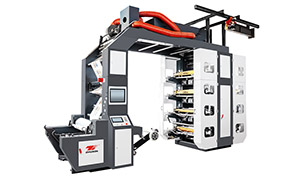
High Speed Flexo Printing Machine - Stack Flexo Flexo Printing Machine
The CI press is the preferred choice for pre-print because it offers superior register accuracy ( ±0.05 mm) and consistent tension control on the thin linerboard. The central drum maintains a constant substrate temperature and short web path, minimizing stretch. The press is equipped with advanced drying systems (hot air for water-based inks, or UV-LED for UV inks) to ensure the ink is fully cured before rewinding. The linerboard tension must be carefully managed to avoid stretching, as the liner is typically 100-300 gsm paper with moderate elastic modulus.
Quality advantages over post-print: Pre-print achieves much higher resolution and color fidelity because the liner surface is smooth and uniform, unlike the rough, fluted surface of finished board. Dot gain is reduced by 5-10%, and solids are denser. The print is also more consistent over long runs, as the press conditions are stable. Pre-print enables process color (CMYK) and metallic effects, which are challenging in post-print. The graphics are protected from flute crush, as the lamination occurs after printing.
Integration with the corrugator: The printed liner roll must be compatible with the corrugator's splice table and tension requirements. The roll diameter and core size must match. The adhesive used for lamination must not interfere with the ink; water-based adhesives are common. Some pre-print lines include an in-line laminator, but most are separate. The registration between the print and the flute structure is not critical for corrugator, but the print repeat length must be consistent to avoid waste during box cutting.
Cost considerations: Pre-print has higher capital cost (CI press) and higher plate costs (more colors, finer screens), but it reduces the need for post-print equipment. It is economically viable for runs >100,000 boxes, where the quality premium justifies the investment. For short runs, post-print is more cost-effective. Pre-print also reduces waste because the liner is printed before fluting, and any print defects only affect the liner, not the whole board.
Maintenance and quality control: The CI press requires regular anilox cleaning, plate inspection, and dryer calibration. The printed liner is inspected with inline cameras for defects. The ink adhesion must be tested after lamination to ensure no delamination. The moisture content of the printed liner must be controlled to prevent warping in the corrugator. By mastering pre-print technology, converters can offer high-end packaging that enhances brand value and shelf appeal.