Flexo Pre-Print: Substrate, Ink, and Drying Optimization for Linerboard at High Speeds
To achieve optimal pre-print results, every aspect of the process must be tailored to the linerboard's characteristics and the subsequent lamination. The linerboard, typically kraft or white-top, has a smooth, sized surface that provides a good printing base. Its porosity and moisture content affect ink drying and dimensional stability. This article provides detailed optimization guidelines.
Substrate selection: Linerboard should have a smooth surface (Bekk smoothness >50 s) and high surface energy (>40 dynes/cm) for good ink wetting. It should have uniform caliper to maintain consistent nip pressure. The moisture content should be 5-7% to avoid shrinking during drying. White-top liner offers better color contrast and is used for high-quality graphics. The basis weight (100-300 gsm) affects the drying load; heavier liners require more energy.
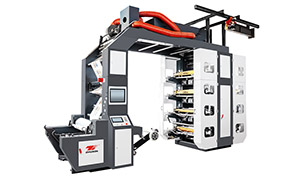
High Speed Flexo Printing Machine - Stack Flexo Flexo Printing Machine
Ink formulation: Water-based inks are standard for pre-print due to low cost and environmental profile. However, they must be formulated to withstand the heat and pressure of the corrugator lamination process without degrading. The resin binder should have high heat resistance (up to 150°C) and good adhesion to both the liner and the adhesive. UV inks are growing for their high gloss and scratch resistance, but they must be flexible to survive the lamination nip. The ink must also have low odor and be safe for food-contact packaging.
Drying optimization: The printed liner must be fully dry before rewinding to prevent blocking. The dryer configuration on the CI press typically includes hot air impingement with temperatures of 80-120°C, and sometimes IR boosters. The drying capacity must match the press speed; for speeds >300 m/min, a long dryer tunnel (8-12 m) is needed. The air flow must be uniform across the width to avoid differential drying and warping. After drying, a chill roller cools the liner to ambient temperature.
Corrugator compatibility: The printed liner's moisture content must be close to that of the unprinted liner to avoid moisture mismatch, which can cause warping. The liner should be rewound with consistent tension to avoid telescoping in the corrugator. The adhesive used in the corrugator (starch-based) must not wash off the ink; a water-resistant ink is preferred. The printed liner's surface must have sufficient roughness (or a primer) to allow good adhesive bonding.
Quality control: The printed liner is tested for adhesion, rub resistance, and heat resistance. A lamination test (e.g., peel test after corrugator) checks the bond strength. The color density and dot gain are monitored online. The press control system adjusts the drying power and anilox pressure based on speed and coverage to maintain consistency.
Troubleshooting: Common issues include warping (due to moisture imbalance), delamination at the corrugator (poor ink adhesion), and blocking (under-drying). Solutions: adjust dryer profile, reduce water content in ink, increase resin binder, or apply a primer. By systematically optimizing these factors,
flexo pre-print achieves high quality and reliable performance in the corrugated packaging line.