Flexo Post-Print Technology: Process, Equipment, and Quality Considerations for Finished Corrugated Board
Flexo post-print is the process of printing on already assembled corrugated board (the finished box blanks). It is the most common method for corrugated printing, used for shipping boxes, e-commerce packaging, and point-of-purchase displays where quality requirements are moderate. Post-print is performed on stack flexo presses with open architecture, allowing easy access for board handling.
The process: Corrugated board sheets (or a continuous web, though sheet-fed is more common) are fed into the post-print press. The press typically has 2-6 color decks, each with anilox roller, plate cylinder, and impression cylinder. The board passes through each deck, receiving a color. Water-based inks are used, drying by absorption and hot air. The printed sheets are then stacked and sent to die-cutting and folding. Post-print presses are designed for thick, rigid boards up to 12 mm, with large impression cylinders and wide gaps.
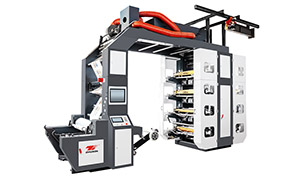
High Speed Flexo Printing Machine - Stack Flexo Flexo Printing Machine
Stack press design: The decks are stacked vertically; each deck has its own impression cylinder, allowing independent adjustment for different board thicknesses. The impression cylinder is often covered with a resilient rubber or foam sleeve to conform to the board's flutes and minimize crush. The frame is heavy-duty to withstand the high forces. The board feeding system uses vacuum belts to ensure accurate registration. The press speed is typically 150-250 m/min for sheet-fed, lower than pre-print.
Impression pressure management: As discussed earlier, the pressure must be sufficient to transfer ink to the flute tips and valleys, but not so high as to crush the flutes. The force is controlled by hydraulic or pneumatic systems. The board's caliper is measured before and after printing to ensure crush is within limits. The impression cylinder's sleeve hardness is chosen based on the board grade; for double-wall, a softer sleeve is used. The plate relief is deeper (0.6-1.0 mm) to bridge the board surface.
Ink and drying: Water-based inks dominate post-print due to their absorption into the board. The drying is mostly by absorption, but hot air dryers are used to remove residual moisture and set the resin. The dryer uses high air velocity at moderate temperature (100-130°C). The board's high thermal mass means it takes longer to heat, so the dryer tunnel is relatively short (1-2 m) as absorption does most of the work. However, for high ink coverage, additional drying may be needed.
Quality factors: Post-print resolution is limited (80-100 lpi) due to the board's rough surface. Dot gain is high (25-35%), so plates are compensated. Solids can have mottle due to uneven board surfaces. Registration between colors is less critical than in pre-print but still important; the press uses edge guides and mark sensors. The board's moisture content must be controlled to avoid warping after drying.
Applications and trends: Post-print is used for shipping boxes, e-commerce packaging, and simple retail displays. With improvements in plate technology (flat-top dots) and anilox, quality is improving. However, for high-end graphics, pre-print is still superior. Post-print remains the most cost-effective method for short runs and variable sizes. The trend is towards automation with quick setup and inline quality inspection.