Flexo Packaging Press Run Length Optimization and Productivity Enhancement Strategies
In the competitive flexible packaging market, maximizing the productivity of flexo packaging presses is essential for profitability. This involves optimizing run lengths (the quantity of meters printed per job), reducing waste, minimizing changeover times, and increasing operating speeds while maintaining quality. This article presents strategies for achieving high overall equipment effectiveness (OEE) on flexo packaging presses.
The first factor is the choice of run length: longer runs amortize setup costs and reduce changeover frequency, but they tie up the press for extended periods and may lead to overproduction. A cost model that balances plate cost, material cost, and setup time is used to determine the economic run length. Typically, for solvent-based inks, runs of 50,000-200,000 linear meters are optimal; for water-based and UV, shorter runs (10,000-50,000) are feasible due to lower plate costs and faster changeovers.
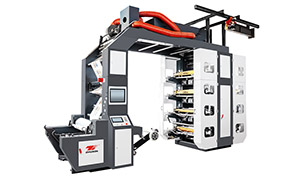
High Speed Flexo Printing Machine - Stack Flexo Flexo Printing Machine
Speed optimization: The maximum press speed is often limited by drying/curing capacity and substrate stability. Increasing speed requires more drying energy, which may cause substrate distortion or incomplete cure. The press's control system can run a "speed trial" where it increments the speed in steps and monitors print quality, drying efficiency, and web tension. The optimal speed is the highest that meets quality specs without exceeding drying capacity. Some presses have dynamic speed control that can increase speed for areas of the job with less ink coverage (e.g., light text) and decrease for heavy solids, but this requires sophisticated dryer modulation.
Waste reduction: Start-up waste (makeready) and running waste are significant. Modern presses with automated impression setting and register control reduce start-up waste from 100-200 meters to 20-30 meters. Running waste (due to defects) is minimized by closed-loop color and register control, and by real-time defect detection that allows immediate correction. Splicing waste is reduced by using zero-speed splicers for both unwind and rewind. The total waste target for a well-run press is under 2%.
Changeover time reduction: As discussed, sleeve technology, automated job recipes, and quick-change doctor blades and anilox systems reduce changeover times to 10-15 minutes for mid-web presses. For wide-web presses, changeovers may take 30-45 minutes due to the larger components. Implementing parallel tasks (e.g., preparing the next job's plates while the current job is running) and using dedicated carts for anilox and plate sleeves further reduce downtime.
Scheduling and sequencing: Optimizing the job sequence can reduce changeover times by grouping jobs with similar ink colors or substrate types, minimizing cleaning between jobs. Some plants use a "production scheduling" software that takes into account the changeover time and material availability to sequence jobs for maximum throughput.
Operator training and standard work: Well-trained operators can run the press more efficiently, diagnose issues faster, and maintain quality. Standard operating procedures (SOPs) for setup, cleaning, and troubleshooting reduce variability. Many converters implement a "lean manufacturing" approach, conducting time studies to identify bottlenecks and implementing improvements.
Monitoring OEE: The press's control system tracks OEE components: availability (uptime), performance (speed compared to ideal), and quality (good output vs. total). Dashboards display real-time OEE, and alerts flag when OEE drops below target. Root-cause analysis of OEE losses leads to targeted improvements, such as replacing worn bearings that cause speed limitations or upgrading dryer to increase capacity.
By systematically addressing each productivity lever,
flexo packaging presses can achieve OEE scores of 75-85%, which is considered world-class. This translates to lower cost per square meter, faster delivery times, and higher profitability, enabling converters to remain competitive in the demanding packaging market.