Flexo Packaging Press Inline Lamination and Film Lamination Dynamics for Multilayer Structures
Flexo packaging presses often include inline lamination stations that bond two or more webs together to create multi-layer structures with enhanced barrier, strength, or sealing properties. This lamination can be done with solvent-based, solvent-less, or water-based adhesives, and the process must be precisely controlled to avoid wrinkles, bubbles, and misregistration.
The lamination station typically consists of an adhesive application unit (similar to a coating head) that applies adhesive to one of the webs, followed by a laminating nip where the second web is brought into contact. The nip pressure and temperature (for heat-activated adhesives) are critical. The adhesive coat weight is controlled by an anilox roller, and the thickness is monitored by a gauge. The two webs must have matched tensions to prevent one from stretching more than the other, which would cause "curling" of the final laminate.
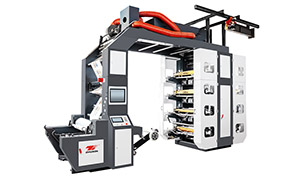
High Speed Flexo Printing Machine - Stack Flexo Flexo Printing Machine
Tension matching: The second web is fed from its own unwind with independent tension control. The two webs' tensions are set such that their total elongation at the nip is equal – this is achieved by measuring the elongation (via encoders) of each web before the nip and adjusting the feed rates. If the tensions are mismatched, the laminate will have residual stress, causing it to bow or twist. Some presses have a "tension isolation" dancer for the secondary web to ensure independent control.
Adhesive curing: After lamination, the adhesive must be cured. For solvent-based adhesives, a drying tunnel with high air flow is used; for solvent-less adhesives (which cure by chemical reaction), the laminate may be passed through a heated zone to accelerate the reaction. For water-based adhesives, the drying is similar to water-based inks. The curing process must be completed before the laminate is rewound; otherwise, the layers may slip or block.
Web guiding for laminates: After lamination, the web becomes thicker and stiffer; the edge guides must be capable of handling the combined web. The guide sensors are placed after the nip, and the correction is applied to both webs simultaneously or individually.
Defect prevention: Common defects in lamination include "orange peel" (uneven adhesive spread), "bubbles" (entrapped air), and "channels" (adhesive-free stripes). To prevent these, the nip roller surface is designed with a slight rubber layer to even out pressure, and a small amount of over-pressure is applied at the edges to squeeze out trapped air. The adhesive viscosity and application temperature are tightly controlled to ensure uniform wetting.
Quality monitoring: Inline inspection cameras detect bubbles and wrinkles immediately after the nip, allowing the press to slow down or stop before significant waste occurs. The laminate's total thickness is measured with a non-contact gauge, and any deviation triggers an alarm.
Changeover considerations: Changing between different laminate structures (e.g., different film types or adhesive systems) requires thorough cleaning of the adhesive applicator and the lamination nip. Quick-change anilox and adhesive supply systems reduce downtime. The press's control system stores the lamination parameters (tension, nip pressure, adhesive volume) as part of the job recipe.
By mastering lamination dynamics,
flexo packaging presses can produce high-quality multi-layer films for food, pharmaceutical, and industrial packaging, offering excellent barrier properties and mechanical strength, all in a single pass, significantly improving production efficiency and reducing handling.