Flexo Label Press Inline Finishing: Lamination, Cold Foil, and Screen Integration
To meet the growing demand for decorative and functional labels, flexo label presses are increasingly equipped with inline finishing modules that go beyond basic printing and die-cutting. These modules include lamination (for protection and tactile effects), cold foil transfer (for metallic effects), and screen printing (for thick, tactile varnish). This article examines the technical integration and process control of these modules.
Lamination unit: This module applies a clear film (usually BOPP or PET) over the printed label to protect against abrasion, moisture, and chemicals, and to add gloss or matte finish. The laminating film is unwound from a separate roll and brought into contact with the printed web at a lamination nip, with adhesive applied either on the film or pre-coated. The lamination nip pressure and temperature (for heat-activated adhesives) must be controlled to achieve bubble-free lamination. The register between the lamination film and the printed image is maintained by a registration system that aligns the film's printed patterns (if any) with the web. The lamination station adds extra tension to the web, which must be compensated by adjusting the web's tension profile.
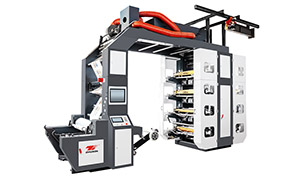
High Speed Flexo Printing Machine - Stack Flexo Flexo Printing Machine
Cold foil transfer: This process transfers a metallic foil (gold, silver, etc.) onto the printed label in specific areas to create premium effects. The cold foil unit consists of a printing station that applies a UV-curable adhesive in the pattern where foil is desired, followed by a foil applicator where the foil web is pressed against the adhesive, and a UV curing unit that cures the adhesive through the foil, bonding it. The foil web then separates, leaving the foil on the adhesive pattern. The challenge is maintaining the foil's web tension and tracking to avoid wrinkles, and ensuring that the adhesive pattern is accurately registered to the printed image. The cold foil unit adds significant length to the press, but it enables metallic effects without the cost of hot foil stamping.
Screen printing unit: This uses a rotary screen cylinder to apply a thick layer of ink or varnish (often with high opacity or tactile texture). The screen printing module is similar to a flexo deck but with a screen cylinder and a squeegee inside. The ink is pushed through the mesh of the screen onto the web, producing a thick film (up to 100 µm). The screen cylinder's mesh count and the squeegee pressure determine the ink deposition. Registration of the screen print to the flexo print is achieved by a separate servo drive and mark sensor. Screen printing is used for braille, spot varnish, or white underprint on transparent films.
Integration and synchronization: All these finishing modules must be synchronized with the printing decks and the die-cutter. The web path through these modules is longer, so tension control becomes more critical. Additional dancer rollers and load cells are placed before and after each module to maintain constant tension. The control system manages the phase offsets for each module, accounting for the web path distance and expected stretch.
Changeover considerations: Switching between jobs with different finishing requirements may involve changing the laminating film, foil roll, or screen cylinder. Quick-change systems for these modules are essential to maintain productivity. The press's job recipe stores the settings (nip pressure, tension, phase offsets) for each module, enabling rapid setup.
Quality control: Inline vision systems inspect the applied foil or lamination for defects (e.g., missing foil, bubbles). The data is used for real-time adjustment. The integration of these finishing modules in a
flexo label press transforms it into a comprehensive converting line, enabling converters to produce high-value labels that command premium prices, with the efficiency of a single-pass process.