Flexo Label Press High-Speed Die-Cutting Integration: Dynamics and Register Control
In a flexo label press, the printing is followed by a die-cutting station that cuts the label shape from the web and separates the waste matrix. At speeds exceeding 300 m/min, the die-cutting process introduces significant dynamic forces that can affect cut accuracy and die life. This article analyzes the mechanics of high-speed rotary die-cutting and the control strategies for maintaining cut-to-print registration.
Rotary die-cutting uses a cylindrical die (with sharp cutting edges) that rotates against an anvil cylinder. The web passes between them, and the die cuts through the face stock and adhesive but not through the liner (for self-adhesive labels) – this is "kiss-cutting." The die's cutting edge must be extremely sharp and precisely matched to the anvil pressure to achieve a clean cut without crushing the liner. The die is driven either by a servo motor synchronized with the press or by a gear train from the main drive.
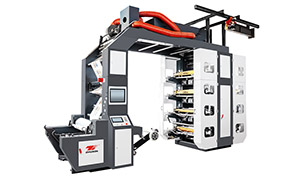
High Speed Flexo Printing Machine - Stack Flexo Flexo Printing Machine
Cut-to-print register: The position of the die relative to the printed image must be accurate. A mark sensor reads a register mark printed on the web, and the die cylinder's phase is adjusted by a servo motor (or a mechanical register unit) to align the cut with the printed shape. However, at high speeds, the web's stretch between the last printing deck and the die causes a time-dependent delay. The control system uses a feedforward compensator based on the web's elastic modulus and the distance. Additionally, the die's rotation is not perfectly uniform due to cutting torque variations; the servo control includes a torque ripple cancellation algorithm that anticipates the load spikes.
Die wear and maintenance: The cutting edge wears over time, especially when cutting abrasive materials (e.g., films with fillers). Worn dies produce ragged edges or incomplete cuts. To prolong die life, the anvil pressure is kept at the minimum required for a clean cut, and the anvil cylinder is made of hardened steel with a replaceable sleeve. Regular inspection of the die with a microscope and periodic resharpening (by grinding) are essential. Some dies have a magnetic base with replaceable blades, allowing blade change without removing the die from the press.
Waste matrix stripping: After die-cutting, the waste matrix (the surrounding material) is stripped off by a series of rollers and rewound as scrap. The stripping tension must be carefully controlled; too high tension can tear the label or stretch the liner, causing register shift; too low and the matrix may break. The press includes a waste rewinder with its own torque control, often with a dancer to maintain constant tension. The stripping point must be close to the die to minimize the risk of labels peeling off.
Die lubrication and cooling: Friction between the die and the web generates heat, which can soften adhesive and cause oozing. Some high-speed presses have a cooling system for the die, such as air jets or a chill roller, to dissipate heat. Lubrication (e.g., a light silicone spray) may be applied to the die to reduce friction and improve cut quality.
Inspection after die-cutting: Inline cameras check the cut quality and the presence of all labels. Defective labels can be marked or diverted. The data is used for statistical process control; if cut quality degrades, the system alerts the operator to adjust pressure or replace the die.
Automation of die change: To reduce downtime, many
flexo label presses feature a quick-change die system where the die and anvil can be swapped as a cartridge. The new cartridge is pre-registered, and the press's control system loads the stored phase offset for that cartridge, reducing setup time to under 5 minutes. By integrating advanced die-cutting technology with the press's control, flexo label presses achieve high-speed, high-quality label production with minimal waste, meeting the demands of the competitive label industry.