Flexo LED Curing: System Integration, Cooling, and Lifetime Management for Press Operation
Integrating UV LED curing into a flexo press requires careful system design to ensure reliable operation and long life. This article covers the key aspects of LED system integration, cooling, and lifetime management.
The LED module consists of an array of LED chips on a substrate, with a protective window and optics (micro-lenses) to focus the light. The module is typically water-cooled or air-cooled. Water cooling is more efficient and allows higher power density; it requires a chiller that circulates deionized water at 20-30°C. Air cooling is simpler but limited to lower power. The cooling system must maintain the LED junction temperature below 80°C to ensure long life; exceeding this temperature accelerates degradation.
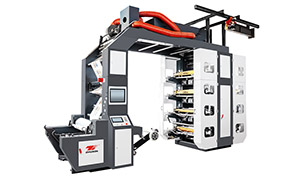
High Speed Flexo Printing Machine - Stack Flexo Flexo Printing Machine
Power supply: The LED module requires a constant current driver with precise current control (typically 0-10A). The driver must have a high efficiency (>90%) and be protected against overcurrent and short circuits. The driver is often housed separately and connected to the module with shielded cables to minimize electrical noise. Dimming is achieved by pulse-width modulation (PWM) or by adjusting the current; PWM is more common.
Lifetime management: The LED's output gradually declines over time (lumen depreciation). The lifetime is defined as the time until the output drops to 70% of initial (L70). For good-quality LEDs, L70 is >20,000 hours at rated current. The depreciation rate increases with temperature; running at lower current and keeping the module cool extends life. The press system tracks the running hours and the cumulative dose, and alerts when the output drops below a set threshold. The output can be measured with a built-in radiometer; the system can then increase the current to compensate (up to a limit).
Integration with press control: The LED curing unit is integrated with the press's speed and ink coverage signals. When the press accelerates, the LED power increases proportionally to maintain constant dose. If the press stops, the LED is turned off instantly (unlike mercury lamps that need to be shuttered). The system also has a safety interlock: if the press stops unexpectedly, the LED shuts off to prevent over-curing.
Maintenance: The protective window must be kept clean; any dust or ink mist reduces UV transmission. The window is cleaned with a soft cloth and a safe solvent. The water-cooling system requires periodic checks of the coolant level, pH, and flow rate; the chiller's compressor and fans need maintenance. The power supply and driver should be inspected for dust and proper ventilation. LED modules are generally reliable, but if a chip fails, the entire module may need replacement; some designs allow individual chip replacement but it is rarely done.
Safety: UV-LED emits UV-A (365-385 nm) which is harmful to eyes and skin. The unit must have a light-tight enclosure and a safety interlock that turns it off if the enclosure is opened. Operators must wear UV-blocking goggles when working near the curing area. The electrical safety must comply with local regulations.
By properly integrating and maintaining the LED curing system, flexo converters achieve consistent, energy-efficient curing with low heat, minimal maintenance, and long service life, making LED the preferred choice for modern flexo production.