Flexo Impression Cylinder: Precision Engineering for Nip Pressure Uniformity and Substrate Integrity
The impression cylinder is the backbone of the flexo printing process, providing the backing force that transfers ink from the plate to the substrate. Its mechanical precision directly determines print uniformity, dot fidelity, and substrate integrity. This article examines the engineering parameters that define an optimal impression cylinder and the practical measures to maintain its performance.
The cylinder must maintain absolute concentricity, with a total indicated run-out (TIR) of less than 0.005 mm across its entire face width. This is achieved through high-precision grinding on a cylindrical grinder with in-process gauging, followed by dynamic balancing to G0.4 grade. The bearing journals are ground in the same setup as the outer surface to ensure coaxial alignment. The cylinder is typically made of hardened steel (58-62 HRC) with a chrome or ceramic coating to resist wear and corrosion. The coating must have a uniform thickness of 0.02-0.05 mm to avoid dimensional variations.
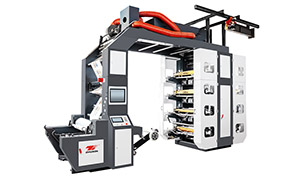
High Speed Flexo Printing Machine - Stack Flexo Flexo Printing Machine
The nip pressure distribution across the web width is critical. The cylinder must have a crowned profile to compensate for deflection under the load of the plate cylinder and the web tension. The crown is calculated based on the cylinder's material, diameter, length, and the expected load; typical crown is 0.1-0.3 mm over the cylinder length. The crown is ground with a computer-controlled profile to achieve a linear or parabolic shape. Some advanced presses use a "pressure map" sensor array that measures the nip pressure in real-time, and the control system adjusts the cylinder's position to equalize the pressure.
Substrate handling: The impression cylinder directly contacts the unprinted side of the web. For films, the cylinder surface must have a fine texture (Ra 0.2-0.4 µm) to provide grip without scratching. For paper and board, a smoother surface (Ra 0.1-0.2 µm) is used to avoid marking. The cylinder's surface energy must be low (via coating) to prevent ink or adhesive build-up. Regular cleaning with a non-abrasive solvent and a soft cloth is essential; abrasive cleaners will damage the coating and alter the surface roughness.
Bearing and preload: The impression cylinder is supported by high-precision angular contact ball bearings or tapered roller bearings. The bearing preload is set to eliminate axial and radial play; typical preload is 50-100 N. The bearings are lubricated with a low-viscosity oil or grease; the lubrication system must maintain a constant temperature to prevent thermal expansion. The bearing housing is often cooled by water circulation to maintain stable geometry.
Thermal management: The impression cylinder absorbs heat from the web (especially in drying zones) and from friction at the nip. Thermal expansion can change the cylinder diameter and thus the nip pressure. To mitigate, the cylinder may have internal cooling channels with circulating coolant, or the press's environmental control maintains a stable temperature. The control system can also apply electronic compensation: the plate cylinder's phase is adjusted to account for the dimensional change.
Maintenance and wear: The cylinder surface is inspected daily for scratches, pits, or deposits. A dial gauge is used monthly to measure run-out; if run-out exceeds 0.01 mm, the cylinder must be re-ground or replaced. The bearings are checked for play and temperature; abnormal heat indicates wear or improper preload. Regular lubrication and alignment checks are essential. By maintaining the impression cylinder to tight tolerances, flexo presses achieve consistent nip pressure, resulting in uniform ink transfer and minimal substrate damage.