Flexo Impression Cylinder: Advanced Materials and Coatings for Extended Wear Life
The impression cylinder's surface must withstand continuous contact with abrasive substrates (paper, board) and the web's edge, while providing consistent grip. Advanced materials and coatings extend cylinder life and improve print quality. This article reviews the options and their performance characteristics.
Traditional chrome plating (hard chrome) offers good wear resistance (hardness 65-70 HRC) and a smooth surface. However, it is prone to chipping and corrosion, especially with water-based inks. Chrome thickness is typically 0.05-0.10 mm. It provides a low coefficient of friction (0.15-0.20) and is easy to clean. Its main disadvantage is the environmental concern with hexavalent chromium plating and the need for periodic re-plating.
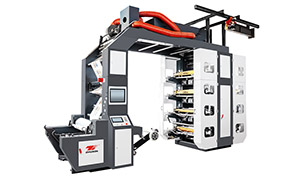
High Speed Flexo Printing Machine - Stack Flexo Flexo Printing Machine
Ceramic coatings (aluminum oxide, chromium oxide) applied by plasma spray or HVOF provide much higher hardness (1200-1400 HV) and wear resistance. They are ideal for abrasive substrates like uncoated paper and board. The surface can be ground to a fine finish (Ra 0.2-0.5 µm). Ceramic coatings have a slightly higher friction coefficient (0.20-0.30) but offer excellent corrosion resistance. They are more expensive than chrome and require specialized grinding equipment. The coating thickness is typically 0.1-0.2 mm.
Tungsten carbide coatings (WC-Co) are the hardest (up to 1600 HV) and most wear-resistant. They are used in high-wear applications, such as printing on filled board or abrasive films. The friction coefficient is 0.25-0.35. The coating is applied by HVOF and ground to a precise finish. The cost is higher than ceramic, but the extended life justifies it for high-volume converters. Some tungsten carbide coatings have a porous structure that can be sealed to prevent ink penetration.
Composite coatings: Some cylinders have a multi-layer structure: a nickel underlayer for corrosion protection, a ceramic top layer for wear, and a thin DLC (diamond-like carbon) overcoat for reduced friction. DLC provides a friction coefficient as low as 0.10 and excellent release properties, reducing ink build-up. However, DLC is expensive and sensitive to damage.
Substrate compatibility: For films, a low-friction coating (chrome or DLC) is preferred to prevent scratching. For board, a high-wear coating (tungsten carbide) is better. The coating must also be compatible with the cleaning solvents used; some coatings are attacked by strong acids or alkalis.
Cylinder reconditioning: When the coating wears or is damaged, the cylinder must be stripped (chemical or mechanical), re-coated, and re-ground. The cost of reconditioning is 30-50% of a new cylinder. Some suppliers offer exchange programs where you return the worn cylinder and receive a reconditioned one, reducing downtime. Regular inspection of the coating thickness (using eddy current or ultrasonic gauges) helps plan for reconditioning before failure.
By selecting the appropriate coating and maintaining it properly, converters can extend impression cylinder life by 2-5 times, reducing long-term operating costs and ensuring consistent print quality across millions of impressions.