Flexo Drying Tunnel: Energy Efficiency and Heat Recovery Systems for Sustainable Operation
Drying is the largest energy consumer in flexo printing, often accounting for 50-70% of total electrical and thermal energy. Improving energy efficiency not only reduces costs but also supports sustainability goals. This article examines the energy balance of drying tunnels and presents heat recovery solutions.
The energy input to the dryer is the heat required to raise the air temperature to the setpoint and to evaporate the solvents/water. The energy output is the heat carried away by the exhaust air, the heat lost through the tunnel walls, and the heat used to raise the substrate temperature. Typically, 40-60% of the energy is lost in the exhaust air. This exhaust heat can be recovered and reused.
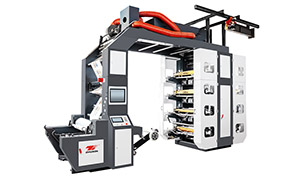
High Speed Flexo Printing Machine - Stack Flexo Flexo Printing Machine
Air-to-air heat exchangers: A plate or tube heat exchanger transfers heat from the exhaust air to the incoming fresh air. The efficiency is typically 50-70%, meaning that the fresh air is pre-heated, reducing the burner load. The exchanger must be designed to handle the corrosive nature of the exhaust (solvent vapors) and to avoid contamination; the two air streams are kept separate. The exchanger requires regular cleaning to prevent fouling.
Thermal wheels (rotary heat exchangers): A rotating wheel with a heat-absorbing matrix rotates between the exhaust and supply air streams. The matrix picks up heat from the exhaust and releases it to the supply. They are more compact than plate exchangers and can achieve 60-80% efficiency. However, they have moving parts and require maintenance; they also may transfer some contaminants if not properly purged.
Heat pump integration: A heat pump can extract heat from the exhaust air and upgrade it to a higher temperature for re-use. The heat pump is powered by electricity but can provide a COP (coefficient of performance) of 3-4, meaning for each unit of electricity, it provides 3-4 units of heat. This is especially effective when the exhaust temperature is moderate (40-80°C). Heat pumps are more expensive but offer flexibility.
Waste heat for plant heating: The exhaust air (after recovery) can be used for space heating in the factory, or to pre-heat process water. This is a simple and effective way to utilize the remaining heat. The air must be filtered to remove any harmful solvents before being used for space heating.
Optimizing the drying parameters: Reducing the air temperature and increasing the air velocity can achieve the same drying with lower energy input, because the heat transfer coefficient increases with velocity. Using a higher solids content ink reduces the water content, thus reducing the evaporation load. Also, using a closed-loop control that adjusts the dryer power based on the actual web moisture content (measured by an IR sensor) prevents over-drying and saves energy.
Monitoring and benchmarking: Install energy meters for the dryer and track the energy consumption per square meter. Benchmark against industry best practices. Identify the baseline and set improvement targets. Regular maintenance of the burner, fans, and heat exchangers ensures they operate at peak efficiency. By implementing heat recovery and process optimization,
flexo drying tunnels can reduce energy consumption by 30-50%, significantly lowering operating costs and carbon footprint.