Flexo Drying Tunnel: Aerodynamic Design and Airflow Optimization for Uniform Evaporation
The drying tunnel is a critical component for water-based and solvent-based flexo inks. Its aerodynamic design determines the evaporation rate and uniformity. This article explores the principles of nozzle design, air flow distribution, and how to achieve uniform drying across the web.
The most effective nozzle is the slot (or air bar) with a narrow, continuous opening that impinges a high-velocity jet onto the web. The heat and mass transfer coefficient is highest at the stagnation point of the jet, with values of h (heat transfer coefficient) reaching 50-150 W/m²·K. The jet's velocity decays with distance; the optimal nozzle-to-web distance (z) is 5-10 times the slot width (d). Multiple slots are arranged in a row; the spacing (pitch) is typically 2-4 times d to avoid jet interference.
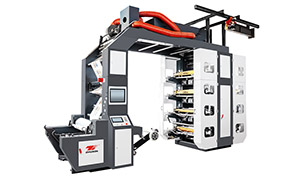
High Speed Flexo Printing Machine - Stack Flexo Flexo Printing Machine
Uniformity across the web width is achieved by ensuring that the air flow is evenly distributed across the full width. This requires a plenum chamber with internal baffles that create a uniform static pressure profile. The plenum must have a large cross-section to reduce velocity, and the distribution holes must be sized to balance the flow. Some dryers have separate zones across the width, each with an adjustable damper to correct any side-to-center variations. The use of a flow straightener (honeycomb) before the nozzle improves uniformity.
CFD modeling is used extensively to design and optimize the dryer. The model simulates the air flow, heat transfer, and evaporation. It predicts the temperature and humidity distribution, and identifies dead zones or high-speed areas. The model is validated with experimental measurements (pitot tube for velocity, thermocouples for temperature). Based on the CFD results, the nozzle geometry, pitch, and plenum design are adjusted to achieve a variation of less than ±5% across the width.
Air recirculation: To save energy, a portion of the exhaust air is recirculated. The recirculation ratio (e.g., 50-80%) must be controlled to maintain the desired air humidity. Too much recirculation increases the humidity, reducing the evaporation driving force. The recirculated air must be filtered to remove ink particles and lint. The mixing of fresh and recirculated air must be uniform; a mixing box with a turbulence grid is used.
Web temperature control: The drying tunnel must also manage the web temperature. Over-heating can cause substrate shrinkage or degradation. The dryer may have a cooling section (chill rollers or air curtains) at the end to bring the web back to ambient temperature. The temperature profile along the dryer can be set to a ramp: lower at entry to avoid shocking, higher in the middle for maximum evaporation, and lower at exit to cool.
Maintenance: The nozzles can become clogged with dust or dried ink; they must be cleaned regularly. The air filters must be replaced per schedule. The fan impellers should be balanced; vibration can be monitored. The temperature sensors and pressure sensors must be calibrated. Regular measurement of air velocity and temperature across the width with an anemometer and thermocouple array ensures the dryer is performing within spec. By optimizing the aerodynamics,
flexo drying tunnels achieve efficient, uniform drying, enabling higher press speeds and better quality.