Flexo Drying System Thermal Management: Heat Transfer Coefficients and Substrate Temperature Control
The core of a flexo drying system is the heat transfer from the hot air to the wet ink film and substrate. Managing this heat transfer is essential to achieve efficient evaporation without damaging the substrate. This article provides a detailed look at heat transfer coefficients, temperature control strategies, and practical methods for thermal profiling.
The heat transfer coefficient (h) is the key parameter; for impinging air jets, h ranges from 50 to 150 W/m²·K depending on the air velocity (10-30 m/s) and nozzle geometry. The heat flux q = h × (T_air - T_web). To evaporate water, the web temperature must be high enough to provide the latent heat (≈2.3 MJ/kg), but not exceed the substrate's maximum safe temperature (e.g., 70°C for PE, 120°C for paper). Thus, the temperature difference (T_air - T_web) is controlled by adjusting T_air and the air velocity. For a given h, a higher T_air gives more heat flux but also raises T_web; the web temperature is determined by the energy balance: q = h×(T_air-T_web) = evaporation rate × latent heat + sensible heat.
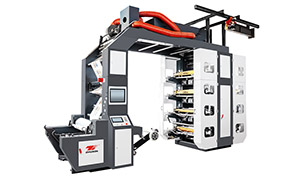
High Speed Flexo Printing Machine - Stack Flexo Flexo Printing Machine
To measure the actual web temperature, non-contact IR thermometers are used. These sensors are placed at multiple points along the dryer to create a temperature profile. The control system uses this feedback to adjust the air temperature or speed. Some dryers have multiple heating zones; each zone can be set to a different temperature to create a "profile" that maximizes drying without overheating. For example, a typical profile for a water-based ink on film: Zone 1 at 60°C (to avoid shocking), Zone 2 at 80°C (main drying), Zone 3 at 70°C (to complete without over-drying).
Substrate thermal properties: The substrate's thermal conductivity and heat capacity affect how quickly it heats up. Thin films (12 µm) have low thermal mass and heat up quickly; thick board (500 µm) has high thermal mass and heats slowly, requiring longer drying or higher temperature. The control system can be programmed with substrate-specific parameters to adjust the drying profile accordingly.
Energy efficiency: To reduce energy consumption, the dryer can be operated at the lowest possible T_air that gives the required evaporation, because the energy loss to exhaust is proportional to (T_air - T_ambient). Heat recovery systems (e.g., air-to-air heat exchangers) can pre-heat the fresh air using the exhaust heat, reducing the load on the burner/electric heater. The efficiency of a recuperative heat exchanger can be 50-70%, saving 20-40% of fuel.
Dynamic control: During acceleration or deceleration, the web speed changes, affecting the residence time. The control system adjusts the air temperature or air velocity proportionally to maintain constant heat input per unit of web length. This is achieved by a feedforward loop that uses the speed signal. Also, when the press stops, the dryers can be turned off or set to a low-temperature mode to avoid overheating the web.
Safety: Overheating can cause film shrinkage, degradation, or even ignition. Temperature sensors with high-limit alarms are mandatory. In solvent-based drying, the air temperature is limited by the auto-ignition temperature of the solvent; typically, the dryer operates below 80% of the LEL and with air dilution.
By mastering thermal management,
flexo drying systems achieve high drying efficiency with minimal substrate stress, enabling higher speeds and better print quality, while also reducing energy costs and carbon footprint.