Flexo Drying System Aerodynamics: Nozzle Design, Air Impingement, and Uniformity Across Web Width
The efficiency and uniformity of a
flexo drying system depend critically on the aerodynamics of the air impingement onto the web. Poor air distribution leads to uneven drying, which causes color variation, cockling, and set-off. This article analyzes the principles of nozzle design and air flow management to achieve uniform drying.
The most common nozzle type is the slot nozzle (or air bar) with a narrow slot that directs a high-velocity air jet onto the web. The jet impinges on the surface, creating a stagnation region where heat and mass transfer are highest. The heat transfer coefficient (h) as a function of jet Reynolds number (Re) and the distance from the nozzle to the web (z) is given by: h ∝ Re^0.75 × (d/z)^0.2 for a single slot. The maximum h is achieved when z/d ≈ 5-8, where d is the slot width. Multiple slots are arranged in a row; the spacing between slots must be optimized to avoid interference of the jets, which can create low-transfer zones.
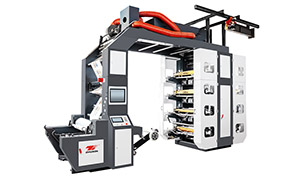
High Speed Flexo Printing Machine - Stack Flexo Flexo Printing Machine
Uniformity across the web width is achieved by ensuring that the air flow is evenly distributed across the full width of the dryer. This requires a plenum chamber with baffles and flow straighteners that produce a uniform pressure profile. The slot width and gap must be constant across the width; any variation causes non-uniform drying, leading to "baggy" edges (over-dried edges vs. under-dried center). Advanced dryers use individually adjustable air bars or zone control with multiple temperature zones across the width, allowing correction of side-to-center variations.
Air recirculation: To save energy, dryers recirculate a portion of the exhaust air. The recirculation ratio (typically 50-80%) affects the air temperature and humidity. The recirculated air must be filtered to remove lint and ink particles; otherwise, they can re-deposit on the web. The mixing of fresh and recirculated air must be uniform to avoid temperature gradients.
Web cooling after drying: After the dryer, the web may be hot (up to 80°C for films), which can cause tackiness or blocking. Cooling sections with chill rollers or air jets are placed after drying. The cooling must be uniform to avoid thermal distortion. The chill roller has internal cooling water circulation; the roller's surface temperature is maintained at 15-25°C.
CFD modeling: Computational fluid dynamics (CFD) is used to simulate the air flow and heat transfer within the dryer. The model incorporates the nozzle geometry, air velocity, temperature, and the web's thermal properties. CFD helps to optimize the nozzle spacing, plenum design, and the placement of temperature sensors. It is also used to design the exhaust system to ensure that solvent vapors are effectively removed.
Maintenance: Nozzles can become clogged with dust or dried ink; regular cleaning is essential. The air filters must be replaced periodically. The fan impellers should be balanced to prevent vibration. Regular measurement of air velocity and temperature across the width with an anemometer and thermocouple array ensures that the dryer is performing within specification. By focusing on aerodynamics, converters can achieve consistent drying quality and reduce energy consumption.