Flexo Coater Printer Hybrid Integration: Coating and Printing in One Pass
A flexo coater printer is a hybrid machine that integrates flexographic printing units with coating stations, enabling the application of functional coatings (adhesives, barrier layers, varnishes) either before, after, or between print colors. This integration reduces handling, improves registration between coating and printing, and enables the production of complex packaging structures like pressure-sensitive labels, barrier films, and laminated materials in a single pass.
The coating station in a flexo coater printer shares many components with a printing deck – anilox roller, doctor blade, and a backing roller – but is configured to apply thicker films (5-50 gsm) compared to typical ink films (1-5 gsm). The anilox volume for coating is much higher, typically 10-40 bcm, with a lower line screen (200-400 lpi) to deliver a uniform continuous layer. The coating material can be hot-melt adhesive, water-based acrylic, solvent-based polymer, or UV-curable lacquer. The coating head's temperature control (for hot-melt) or viscosity control (for solvent/water) is critical to maintain the desired coat weight.
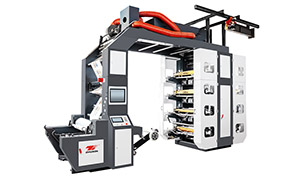
High Speed Flexo Printing Machine - Stack Flexo Flexo Printing Machine
Process integration: The coater can be placed at the beginning (pre-coat to prime the substrate), in the middle (between colors for inline lamination), or at the end (overprint varnish or adhesive). For PSA label production, the adhesive is typically coated on the liner or the face stock, often after the printing and before the lamination of the liner and face. The register between the printed image and the adhesive pattern (if pattern-coated) must be maintained; the coater's drive is synchronized with the printing decks. Some coaters use a "kiss" coating technique where the applicator roller just touches the web, leaving a controlled pattern.
Coating uniformity and thickness control: The thickness of the coating is determined by the anilox volume and the transfer efficiency, which is affected by the coating's rheology and the nip pressure. To achieve uniform thickness, the coater has a precise nip pressure control system with feedback from a thickness gauge (e.g., a beta-ray or infrared sensor). The controller adjusts the anilox pressure or speed to maintain the target coat weight. For hot-melt adhesives, the temperature must be stable within ±1°C to keep viscosity constant; the coating head is jacketed with circulating oil or electric heating.
Drying and curing of coatings: Coatings often require more extensive drying than inks due to their higher thickness. The coater may be followed by a dedicated drying tunnel with higher capacity, or a multi-zone dryer. For UV coatings, high-power UV lamps are used. The integration of the coater with the drying system must account for the added heat and its effect on the substrate; a cooling section may be needed before subsequent printing.
Material compatibility: The coater must handle a wide range of coating viscosities (from 100 cps for solvent-based to 50,000 cps for hot-melt). The anilox and doctor blade materials must be compatible with the coating chemistry (e.g., corrosion-resistant for acidic coatings). The coating head may have a closed chamber to prevent solvent evaporation and to recover excess coating.
Changeover and cleaning: Switching between coating types requires thorough cleaning of the coating head and the anilox. The design should allow quick disassembly and wash-up. Some coaters use a "quick-change" anilox sleeve to swap volumes quickly. The ink and coating paths should be independent to avoid cross-contamination.
Quality monitoring: Inline sensors for coat weight and visual appearance (streaks, pinholes) are essential. The data is used for closed-loop control. The
flexo coater printer is a powerful tool for converters looking to add value by combining printing with functional coatings, reducing process steps, and improving product performance, such as enhanced barrier properties or better adhesion, all while maintaining high productivity and low waste.