Dynamic Impression Pressure Transfer Principle and Segmented Impression Setting for Wide Web Flexo Press
This deep technical content explains dynamic pressure transfer mechanism between plate cylinder and impression cylinder,introduces segmented independent impression setting technology for wide web presses,and solves full-width uneven pressure defects.
Flexo impression setting refers to precise adjustment of contact pressure between plate cylinder assembly and impression cylinder,which is the core parameter controlling ink transfer thickness and dot reproduction quality.Impression pressure is not uniform linear mechanical pressure,but dynamic elastic contact pressure changed by plate resilience,tape buffer and substrate thickness together.
Insufficient and excessive impression pressure bring opposite printing defects.Low impression pressure leads to incomplete ink transfer,faint pattern color and hollow halftone dots.Excessive impression pressure causes severe dot gain,pattern edge extrusion deformation and even substrate back penetration ink pollution.
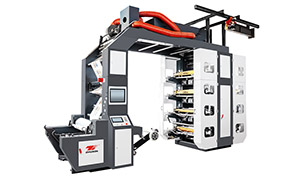
High Speed Flexo Printing Machine - Stack Flexo Flexo Printing Machine
Full-width pressure unevenness pain point of traditional integral impression cylinder.Traditional overall single pressure setting cannot eliminate pressure difference between web center and two edges.The cylinder produces subtle bending deformation under long-term pressure,resulting in higher pressure in the middle and lower pressure at both edges,causing darker central color and lighter edge color on printed webs.
Segmented independent impression pressure setting solves full-width pressure deviation fundamentally.The impression cylinder is divided into three independent pressure control zones:left edge,middle area and right edge.Technicians set targeted pressure values for each zone according to real-time pressure detection data to realize consistent pressure across full printing width.
Impression pressure dynamic compensation following printing speed increase.Higher running speed enhances cylinder vibration and reduces actual effective contact pressure.The system automatically increases impression pressure by 3% when speed rises per 100m/min to offset dynamic pressure loss caused by high-speed mechanical vibration.
Impression pressure matching standards for mainstream substrates:thin film substrates need 0.12MPa low impression pressure to avoid film stretching deformation;common paper needs standard 0.18MPa pressure;thick corrugated board needs 0.25MPa high impression pressure to ensure complete ink transfer on rough surfaces.