Corrugated Flexo Printer Post-Print vs. Pre-Print: Process Comparison and Suitability
Corrugated flexo printing is performed either as post-print (printing on the assembled corrugated board) or pre-print (printing on the liner before it is laminated to the flute). Each method has distinct technical requirements, quality outcomes, and economic profiles. This article compares the two processes to guide the selection for specific products.
Post-print is the traditional method: the corrugated board is printed after fluting and lamination. The board is fed as sheets or a web through a stack flexo press with impression cylinders that contact the board's surface. The ink is water-based, and drying is by absorption and evaporation. The advantages: simple process, low plate cost, and ability to print on both sides (if the press has two-sided printing). However, the board's rough surface and flutes limit print quality – maximum resolution is about 80-100 lpi, and fine details are difficult. Also, the drying process can cause board warping if not controlled.
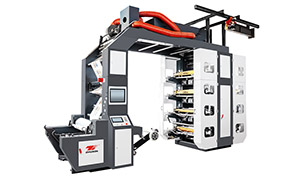
High Speed Flexo Printing Machine - Stack Flexo Flexo Printing Machine
Pre-print involves printing on the linerboard (the outer paper layer) before it is laminated to the fluted medium. The liner is printed on a high-quality CI flexo press with high line screens (up to 150 lpi) and better registration, as the liner is smooth and flat. The printed liner is then laminated onto the flutes. This yields superior graphics, with crisp dots, vibrant colors, and excellent coverage. Pre-print is the choice for retail packaging and displays that require high visual impact. The disadvantages: higher plate cost (because of the more elaborate process), additional converting steps, and the need for a laminator. Also, the registration between the print and the flute structure (which may show as a "flute shadow") must be managed.
Substrate handling: In post-print, the press must accommodate thick, stiff board; the impression cylinders are large, and the web path is designed for rigidity. In pre-print, the liner is thin and flexible, so the press can run at higher speeds (up to 400 m/min) and uses CI presses with tension control typical of film presses.
Quality and performance: Pre-print offers significantly better quality, with dot gain controlled to 10-15%, and can reproduce process work for consumer brands. Post-print is adequate for shipping boxes, one- or two-color designs, and simple graphics. Pre-print is also more consistent, as the liner's surface is more uniform than the assembled board.
Cost analysis: Post-print has lower capital cost (stack presses are cheaper than CI presses) and lower plate cost. However, the waste from post-print (due to registration issues) and the lower speed reduce productivity. Pre-print requires an additional laminator, but the overall production speed is higher, and the quality allows for higher product value. For long runs (over 100,000 boxes), pre-print becomes cost-effective; for short runs, post-print is more economical.
Application examples: Post-print is used for e-commerce shipping boxes, fruit boxes, and industrial packaging. Pre-print is used for point-of-sale displays, cereal boxes (if the print is on the outside liner), and high-end beverage carriers.
Hybrid approaches: Some converters use pre-print for the outer liner and post-print for the inner liner (if visible). Others use a "print on the roll" approach where the board is printed before it is cut and folded, which is a variant of post-print.
In summary, the choice between post-print and pre-print depends on the quality requirements, run length, and budget. Corrugated flexo printers are often specialized; however, some machines can handle both by having an impression system that accommodates varying thicknesses and a drying system that works for both liner and board. Understanding the technical differences helps converters to select the right equipment and process for each job, maximizing profitability and customer satisfaction.