Corrugated Flexo Printer Heavy-Duty Impression Mechanisms and Flute Protection
Corrugated flexo printers are designed to print on the uneven, compressible surface of corrugated board. The impression mechanism must provide sufficient pressure to transfer ink to the fluted surface without crushing the flutes, which would weaken the board's structural integrity. This article examines the engineering of impression systems for corrugated printing.
The primary challenge is that corrugated board consists of a fluted medium sandwiched between linerboards. The printing pressure must bridge the valleys of the flutes to contact the tips. Traditional impression systems use a steel cylinder with a compliant covering (rubber or foam) that conforms to the board's surface. The covering material is chosen for its resilience; it must compress enough to contact the flute valleys but spring back to avoid permanent deformation. The hardness of the covering is measured on the Shore A scale; typical values are 60-80 for normal board, with softer materials (40-50) for heavy-duty double-wall to prevent crushing.
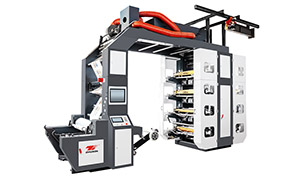
High Speed Flexo Printing Machine - Stack Flexo Flexo Printing Machine
Impression force control: Instead of a fixed gap (which would crush the board), modern corrugated flexo printers use a force-controlled system. A hydraulic or pneumatic cylinder applies a constant force to the impression roller, while the gap is allowed to float. The force is set based on the board thickness and flute geometry. Sensors measure the actual force and adjust the pressure regulator to maintain consistency. This ensures that the board is not over-compressed even if there are variations in thickness.
Impression cylinder design: The impression cylinder in corrugated printers is often a large-diameter roller (up to 600 mm) to reduce the angle of wrap, which helps prevent board bending. The cylinder surface may have a grooved pattern to improve grip and reduce marking. For post-print applications, the cylinder is wider than the printing deck to allow printing across the entire board width.
Register and pressure correlation: Higher impression pressure increases ink transfer, but also increases dot gain and risk of flute crush. The optimal pressure is found by printing a test pattern and measuring both print density and the board's remaining compression strength (by a simple crush test). Most converters establish a "pressure-density" curve for each board type, and the press's control system uses this curve to set the pressure automatically.
Substrate feeding and handling: Corrugated boards are fed into the printer either as sheets (sheet-fed) or as a continuous web (for pre-print). For sheet-fed, the impression cylinder acts as the feed roller; the sheets must be precisely aligned. For web-fed, the tension is low to avoid stretching, and the impression cylinder engages the board with minimal nip force to prevent distortion.
Maintenance of impression covers: The resilient covering on the impression cylinder wears over time and becomes glazed, reducing its conformity. Regular replacement of the covering is necessary; some covers are replaceable sleeves, allowing quick change. The cover's thickness must be uniform across the width; any variation causes uneven pressure and print defects.
Monitoring flute crush: Some advanced presses include an inline thickness gauge that measures the board's caliper after printing to detect any permanent crushing. If the caliper reduction exceeds a threshold, the system adjusts the impression force downward. This real-time feedback loop ensures that the board's integrity is maintained while achieving the required print quality.
By designing the impression system with force control, compliant rollers, and feedback sensors,
corrugated flexo printers achieve sharp, dense prints without compromising the board's strength, which is essential for shipping containers where stacking strength is critical.