Common Operation Errors and On-site Troubleshooting for Flexo Printing Machines
This article summarizes eight common manual operation errors in daily flexo machine production, analyzes corresponding printing defects and machine faults caused by misoperation, and provides one-click on-site quick troubleshooting solutions for frontline operators.
Most sudden flexo machine faults and printing quality defects are not caused by equipment hardware damage, but irregular manual operation errors from frontline operators. Improper pressure adjustment, wrong tension setting, unsynchronized startup sequence and untimely ink system switching will directly induce avoidable production problems and increase production waste cost.
Improper impression pressure adjustment is the most common operation error. Many operators set excessive printing pressure blindly to solve faint printing patterns, resulting in severe dot gain, substrate extrusion deformation and accelerated plate cylinder surface wear. Insufficient pressure conversely leads to incomplete ink transfer and hollow halftone dots.
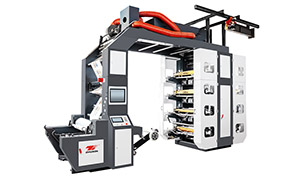
High Speed Flexo Printing Machine - Stack Flexo Flexo Printing Machine
Unsynchronized tension and speed matching error. When raising printing speed, operators forget to increase web tension synchronously, causing web slack and transverse web drift. When reducing speed, delayed tension reduction leads to substrate stretching and longitudinal register deviation. Speed and tension must be adjusted synchronously with consistent changing amplitude.
Ink system switching sequence error. Operators turn off ink circulation pump before machine full stop, leading to residual ink static precipitation inside anilox roller microcells. After long-time shutdown, precipitated ink blocks roller cells and affects subsequent ink metering effect. The correct sequence is stopping machine first then closing ink circulation system.
Neglected pre-run jogging operation. Some operators start high-speed production directly after power-on without low-speed jogging. Cold machine operation aggravates mechanical gear and servo motor wear, and unstable initial operation state causes continuous register deviation in early production stage.
Quick troubleshooting guidance for typical operation errors. Once stripe defects appear, check doctor blade installation state firstly; once color fading happens, verify ink viscosity parameter; once register drift occurs, inspect tension parameter setting. Targeted error checking can solve on-site operation faults within several minutes without long downtime.