Central Impression Flexo Print Quality Optimization: Anilox - Plate - Substrate Matching
In central impression (CI) flexo printing, achieving optimal print quality requires a systematic approach to matching the three core elements of the printing system: the anilox roller (ink metering), the photopolymer plate (image carrier), and the substrate (ink receptor). Each element has properties that interact non-linearly, and the best combination depends on the required print attributes: density, dot gain, resolution, and solid coverage. This article provides a framework for selecting and matching these components for different print jobs.
The anilox roller is defined by its line screen (lpi) and cell volume (bcm, billion cubic microns per square inch). A higher line screen (e.g., 800-1200 lpi) with smaller cell volume (1.5-4 bcm) is used for fine detail and low ink film thickness, reducing dot gain. A lower line screen (e.g., 250-400 lpi) with larger volume (8-15 bcm) is chosen for heavy solids and dense colors, but it tends to produce higher dot gain. The plate's dot structure and relief depth must match the anilox to ensure proper ink transfer without filling the dots. Generally, a flat-top dot plate with a moderate relief (0.3-0.5 mm) works well with high line screen anilox for process printing.
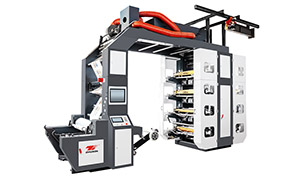
High Speed Flexo Printing Machine - Stack Flexo Flexo Printing Machine
Substrate characteristics: The substrate's surface energy, roughness, and absorbency dictate the required ink formulation and the optimal anilox-volume-plate combination. For non-porous films (PE, PP), a low-volume anilox (2-4 bcm) and a high line screen (800+) are used to deposit a thin ink layer that dries/cures without slumping, preserving dot sharpness. For rough paper or board, a higher volume anilox (5-8 bcm) and lower line screen (400-600) are needed to fill the irregularities and achieve full color coverage, but dot gain will be higher – compensated by reducing plate dot sizes.
The matching process can be guided by the "print contrast" metric, defined as (D_solid - D_75% tone) / D_solid, where D are densities. Optimal print contrast occurs when the ink film thickness is just enough to saturate the solid without excessive dot gain. This is achieved by choosing an anilox volume that, together with the plate's transfer efficiency, yields the target solid density (typically 1.3-1.8 for process colors) while minimizing gain in the mid-tones. A test form with varying anilox volumes and plate exposures is used to establish the best combination for a given substrate.
The plate's screening technology also matters: hybrid screening (AM for dots, FM for highlights) can improve tone transitions, and the anilox line screen should be at least 4-5 times the plate's maximum screen ruling (e.g., for 150 lpi halftones, anilox 700+ lpi) to avoid moiré patterns. The anilox cell geometry (hexagonal vs. oblique) affects ink release; oblique cells have better release and are preferred for high-speed CI presses.
Process control: Once the matching is established, the press settings – impression pressure, anilox-to-plate nip, doctor blade angle – must be optimized. Too much impression increases dot gain; too little causes mottling. This is often done using a statistical design of experiments (DOE) to find the sweet spot. Modern CI presses with automated impression setting can replicate these settings from stored job recipes, ensuring consistency across runs.
Troubleshooting mismatches: If the print shows "dot bridging" (dots touching), the anilox volume is too high or the impression too heavy; reduce volume or pressure. If the solid is weak and grainy, anilox volume is insufficient or plate too hard; increase volume or use softer plate. If highlight dots (1-3%) are missing, the plate relief is too shallow or the anilox screen too coarse; consider a finer anilox or deeper relief. Regular measurement of print samples with a spectrophotometer and dot gain analyzer provides feedback for continuous improvement.
Case study: For a CI press running 8-color process on BOPP film at 400 m/min, the optimal match was found to be an 800 lpi anilox with 3.2 bcm, a 0.3 mm relief flat-top plate with 40 Shore A hardness, and an impression setting of 0.15 mm deflection. This achieved solid density of 1.5 (Cyan), dot gain of 14% at 50% tone, and a print contrast of 0.42 – delivering exceptional quality for food packaging. By documenting such combinations, CI flexo converters can build a library of "standard recipes" that drastically reduce setup time and ensure predictable quality, leveraging the press's repeatability to meet the highest brand standards.