Central Impression Flexo Press Web Transport Dynamics and Slippage Prevention
In a central impression flexo press, the web is wrapped around a large drum and must maintain perfect speed synchronization with the drum surface to avoid slippage, which would cause register errors and print distortion. The web-drum interface is governed by friction, tension, and the drum's surface characteristics. This article delves into the mechanics of web transport and presents strategies to prevent slippage at high speeds.
The fundamental requirement is that the web velocity equals the drum surface velocity at all points of contact. Since the drum is driven by a motor and the web is pulled through the press by the downstream tension, any difference leads to relative motion. The friction force between the web and drum must be sufficient to transmit the required drag from the upstream and downstream tension differentials. The friction coefficient (µ) for typical web-drum pairs is 0.2-0.4 for film on chrome, and 0.4-0.6 for paper on ceramic. The maximum friction force is µ × N, where N is the normal force (the web tension multiplied by the wrap angle). For a 180° wrap, the holding capacity is substantial, but at high speeds and low tension (e.g., thin films), the margin is reduced.
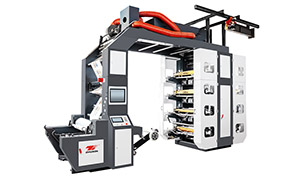
High Speed Flexo Printing Machine - Stack Flexo Flexo Printing Machine
Slippage occurs when the required tractive force exceeds the friction limit. Causes include: insufficient tension, low drum surface roughness, contamination (oil or ink on the drum), or sudden acceleration/deceleration. Slippage manifests as repeat length shift between colors, loss of register, and sometimes web wrinkling. To prevent this, CI presses employ a multi-pronged approach: tension profiling, surface engineering, and active speed matching.
Tension profiling: The web tension is maintained at a level that provides adequate normal force but without overstretching the substrate. For films, typical tension is 0.5-1.5 N/cm width. The tension is controlled by the unwind and rewind motors, with dancer rollers providing isolation. The tension profile is set to increase slightly in the printing zone to ensure firm contact, but not so high as to cause deformation. Some presses have a "tension gradient" – higher at entry to the drum, lower at exit – to enhance friction.
Drum surface engineering: The drum surface is often coated with materials that increase friction, such as a fine ceramic texture or a plasma-sprayed tungsten carbide layer with controlled roughness (Ra 0.4-0.8 µm). Some drums have a "micro-groove" pattern that creates additional mechanical interlock with the web, especially for films. However, too rough a surface may scratch the substrate; a balance is required. Cleaning the drum regularly with a non-abrasive solvent removes contaminants that reduce friction.
Active speed matching: The drum and the web are independently driven; the drum's surface speed is the master reference, and the web speed is controlled by the nip forces and tension. To ensure matching, the press control system uses an encoder on the drum and a tachometer on a feed roller to compare speeds. If a slight speed difference is detected, the unwind motor is adjusted to fine-tune the web speed. This is a closed-loop system with a bandwidth of several hertz, capable of correcting rapid deviations.
Handling acceleration and deceleration: During speed changes, the web's inertia causes a transient tension spike. Advanced presses use a "speed ramp" profile that smoothly accelerates to avoid sudden shocks. Additionally, a dancer roller with an air cylinder provides a compliance buffer that absorbs short-term mismatches. The system also monitors the web's elongation during speed changes and compensates by modulating tension.
Monitoring slippage: Some presses incorporate a slip detection system that uses two encoders – one on the drum and one on a non-driven idler roller that contacts the web. If the web's speed differs from the drum by more than a threshold (e.g., 0.05%), an alarm is triggered, and the press may automatically reduce speed or adjust tension to re-synchronize. This proactive monitoring prevents catastrophic register failures and reduces waste.
Best practices for operators: Always use the correct tension setting for the substrate; avoid sudden speed changes; keep the drum surface clean; and regularly check the friction coefficient with a simple pull test. For problematic films (e.g., very low friction, heavily metallized), consider using a drum sleeve with a higher friction coating or increasing the wrap angle (some presses allow adjustable roller positions to increase wrap). By mastering web transport dynamics, CI flexo presses can achieve consistent register and superior print quality even at the highest speeds, making them the preferred choice for demanding film packaging applications.