CI Flexo Press Print Geometry and Distortion Compensation for Sleeve Printing
Printing on a CI flexo press introduces unique geometric challenges because the substrate is wrapped around a large central drum, and the print repeat length is determined by the drum circumference plus any substrate stretch or shrinkage. The relationship between the plate cylinder circumference, the drum circumference, and the substrate's mechanical properties determines the final printed image dimensions. This article details the geometric factors and compensation methods to achieve accurate printed dimensions.
The fundamental geometry: In a CI press, each printing deck's plate cylinder contacts the web which is supported by the drum. The theoretical repeat length is equal to the drum circumference if the web has no stretch and the plate cylinder circumference matches the drum's. However, in practice, the web is under tension, causing it to elongate slightly between the print nip and the point where it leaves the drum. The effective repeat length becomes L = π × D_drum × (1 + ε_web), where ε_web is the web strain (typically 0.2-2% depending on tension and substrate). Moreover, the plate itself may be stretched when mounted on its cylinder, affecting its circumference.
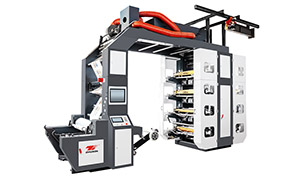
High Speed Flexo Printing Machine - Stack Flexo Flexo Printing Machine
Sleeve technology introduces additional variables: sleeves are mounted on an air-cushioned mandrel; the sleeve's inner diameter, wall thickness, and material modulus affect its expansion when inflated. The plate is then mounted on the sleeve, and the combined assembly has a certain effective circumference that must match the desired repeat length. Sleeves are available in various thicknesses to allow fine-tuning of repeat length by 0.1-0.5 mm increments. The plate mounting tape thickness also contributes, typically 0.2-0.5 mm, which effectively increases the cylinder diameter.
Distortion compensation for shrink sleeves: When printing for shrink sleeve labels, the artwork must be pre-distorted (compressed or stretched) in the machine direction because the film shrinks during application. The shrinkage ratio (e.g., 40-70% in the transverse direction, minimal in machine direction) is known from the film's specifications. The prepress software applies a non-linear distortion to the artwork, effectively oversizing the print in the machine direction to compensate for the eventual shrinkage. The CI press's repeat length must also be set to match the distorted artwork dimensions, requiring accurate measurement of the sleeve's shrinkage behavior under the application conditions.
Plate mounting and registration: To achieve a specific repeat length, the plate cylinder or sleeve is chosen such that its circumference equals the desired repeat length divided by the number of print repeats per revolution (typically one). Plate cylinders are available in increments of 1/8 inch or 1 mm; for finer adjustments, mounting tape thickness or sleeve expansion pressure can be varied. Some presses have a "repeat length control" that uses a secondary motor to slightly overspeed or underspeed the plate cylinder relative to the drum, effectively changing the repeat length continuously – this allows dynamic correction during run.
Dynamic compensation: The control system monitors the repeat length by reading printed marks and comparing to a reference. If the substrate stretches due to tension variation, the system adjusts the plate cylinder speed relative to the drum. This closed-loop repeat length control is essential for maintaining consistent cut-off in downstream converting. The compensation can be as fine as 0.01 mm per meter of web.
Mathematical model: The total repeat length L_total = L_drum × (1 + ε_web) × (1 + ε_plate + ε_tape), where ε_plate is the plate stretch during mounting. By knowing the drum diameter, web tension, plate material stiffness, and tape compliance, one can calculate the required plate cylinder circumference. In practice, trial prints are used to calibrate the model, and the press stores correction factors for each substrate-plate combination.
Best practices: Always measure the substrate's elongation at the operating tension before printing. Use sleeves with thicknesses that match the desired repeat length as closely as possible, and rely on fine adjustments via tape or electronic compensation. Regularly calibrate the repeat length sensor. For multi-color work, ensure all decks are set to the same repeat length; mismatched repeats cause color-to-color drift. Advanced CI presses now feature "predictive repeat control" that uses a physical model of the substrate's behavior to anticipate stretch and adjust preemptively, minimizing registration errors and waste. This geometry mastery is the key to successful CI flexo printing, especially for demanding applications like shrink sleeves and high-end packaging.