CI Flexo Press Central Drum Engineering: Concentricity, Surface Finish, and Cooling
The central impression (CI) drum is the defining component of a CI flexo press, serving as both the substrate support and the reference surface for all print decks. Its mechanical perfection dictates the overall press performance – any deviation in concentricity, surface flatness, or thermal stability immediately transfers to every color station. This article explores the engineering challenges and solutions in designing and maintaining the CI drum.
Concentricity and run-out: The drum must rotate with a total indicated run-out (TIR) of less than 0.005 mm, measured on a high-precision spindle. This is achieved by grinding the outer surface after the drum is mounted on its bearings, and by using hydrostatic or hydrodynamic bearings that eliminate metal-to-metal contact. The drum's shaft and bearing journals are ground in a single setup to ensure perfect alignment. Any deviation causes a periodic impression variation, resulting in "barring" or "banding" defects. The drum must also be dynamically balanced to G1.0 grade to prevent vibration at high speeds.
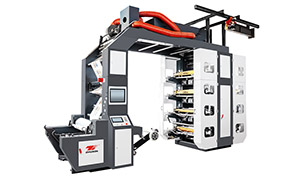
High Speed Flexo Printing Machine - Stack Flexo Flexo Printing Machine
Surface finish and coating: The drum surface contacts the unprinted side of the substrate, and its finish must provide sufficient grip to prevent web slippage, yet be smooth enough not to scratch the substrate. Typical surface roughness (Ra) is 0.2-0.4 µm. A hard chrome coating (70-75 HRC) or a ceramic coating (e.g., tungsten carbide) is applied to resist wear from abrasive substrates (paper, board) and to facilitate cleaning. The coating must have uniform thickness and adhesion; any porosity can trap ink or contaminants. Some drums have a micro-smooth finish with a subtle "orange peel" texture for improved traction on films.
Cooling system design: The drum generates heat from friction with the web (especially at high speeds) and from external dryers. To maintain a constant temperature (typically ±1°C), the drum incorporates a network of cooling channels. In the most common design, a spiral or multi-pass channel runs inside the drum wall, carrying chilled water at 20-30°C. The flow rate and inlet temperature are controlled by a chiller with a PID loop. The channel geometry is optimized using CFD to ensure uniform heat extraction across the drum width; otherwise, a temperature gradient causes thermal bow (the drum becomes convex or concave), altering the nip geometry across the width – a catastrophic effect for register.
Thermal expansion compensation: Even with cooling, the drum may warm up during operation, increasing its diameter. Since all decks are referenced to the drum surface, this expansion increases the repeat length of the print. Modern CI presses include a thermal compensation feature: a temperature sensor on the drum surface feeds back to the control system, which adjusts the plate cylinder's relative speed (phase) to keep the repeat length constant. This is especially critical when printing on films with low elongation tolerance.
Maintenance and inspection: The CI drum surface must be inspected daily for scratches, pits, or foreign material deposits. Cleaning is done with a soft cloth and approved solvents – abrasive cleaners are forbidden. Periodically, the drum's run-out is measured with a dial gauge; if it exceeds the tolerance, the drum may need to be re-ground or re-coated. The bearing preload and lubrication are checked weekly; improper bearing adjustment leads to drum wobble.
Advanced drum technologies: Some presses use a segmented drum where the outer surface is composed of replaceable sleeves, allowing quick change of surface properties (e.g., different roughness for different substrates). Others incorporate sensors embedded in the drum to measure web tension or temperature directly at the point of contact. The trend is towards active cooling with variable flow rates based on the actual measured temperature profile, minimizing thermal gradients. The CI drum remains the most expensive and precisely manufactured component of the press, and its care directly impacts the press's ability to produce consistent high-quality prints at high speeds. Investing in a well-engineered drum and its cooling system is essential for any high-performance
CI flexo press.