Buy Flexo Printing Machine: Financial Justification and ROI Modeling for Capital Investment
Beyond technical specifications, the purchase decision hinges on financial justification. A robust ROI model considers not only the machine's price but also the total cost of ownership (TCO), productivity gains, and market opportunities. This article provides a framework for financial analysis.
The machine's cost includes the base price, installation, training, shipping, and any import duties. Additional costs: anilox rollers, plate sleeves, spare parts, and a recommended spare parts kit. The total initial investment can be 20-30% higher than the base price. Financing options: bank loans, leasing, or equipment financing; the interest rate and term affect the monthly cost.
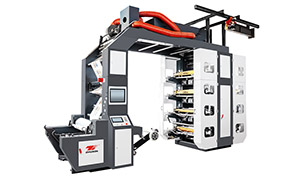
High Speed Flexo Printing Machine - Stack Flexo Flexo Printing Machine
Revenue projection: Estimate the annual production capacity based on the press speed, width, utilization (typically 70-85%), and uptime. Multiply by the average selling price per square meter (or per label) to get the potential revenue. Consider that the new press may allow entry into new markets (e.g., pre-print) or higher value jobs, increasing the average price.
Operating cost savings: The new press may have lower waste (due to better automation), lower energy consumption (e.g., LED curing), and reduced labor (due to automation). Quantify these savings per year. For example, reducing waste from 5% to 2% on a 10 million m²/year line saves 300,000 m² of substrate, worth thousands of dollars. Energy savings from LED over mercury lamps can be $10,000-$30,000/year.
Payback calculation: Payback period = (Total investment) / (Annual net cash flow). Annual net cash flow = (Revenue - Operating costs - Depreciation) × (1 - tax rate) + Depreciation. A payback of 2-3 years is typical for flexo presses. The internal rate of return (IRR) should exceed the cost of capital.
Sensitivity analysis: Vary key assumptions (speed, utilization, waste) to see the impact on ROI. Identify the break-even point – the minimum utilization required to achieve a positive return. This helps in decision making under uncertainty.
Financing and leasing: Leasing can preserve capital and offer tax advantages. Compare lease vs. buy options. Some manufacturers offer performance-based guarantees (speed, waste), which can be tied to financing terms.
Case example: A converter investing $2 million in a mid-web CI press with LED and automation projects $5 million annual revenue, $3.5 million operating costs, $200k depreciation; net cash flow = $1.3 million, payback = 1.5 years. IRR = 35%. With conservative assumptions (60% utilization), payback extends to 2.5 years. The analysis shows the investment is viable. By conducting a thorough financial justification, converters can confidently invest in flexo printing machines that enhance competitiveness and profitability.