Anilox Roller Based Flexo Ink Metering Principle and Precision Control Method
This article elaborates core flexo ink metering principle based on anilox roller and doctor blade system, analyzes factors affecting ink metering accuracy, and provides high-precision ink metering control schemes for different printing patterns.
Flexo ink metering is a fixed-volume ink supply mode different from offset printing, relying on laser engraved anilox roller microcells to store quantitative ink and doctor blade to scrape redundant ink. The final ink transfer volume is completely determined by anilox cell volume and blade scraping effect, realizing quantitative and stable ink supply for each printing cycle.
Three core factors affecting
flexo ink metering precision: anilox roller cell volume consistency, doctor blade scraping uniformity and real-time ink viscosity fluctuation. Uneven cell volume leads to transverse ink density difference; blade vibration causes longitudinal stripe defects; viscosity change alters ink release rate from microcells.
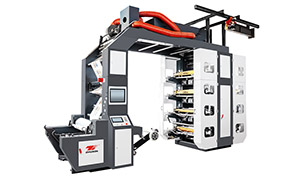
High Speed Flexo Printing Machine - Stack Flexo Flexo Printing Machine
High-line and low-line anilox roller matching for differentiated ink metering demands. Low-line anilox rollers with large cell volume are used for solid color background printing to supply thick ink layer and ensure high color density. High-line fine cell rollers adopt small fixed ink volume for gradient and fine dot printing to realize thin uniform ink layer and avoid dot gain.
Hydrodynamic pressure compensation for high-speed ink metering. At high printing speed, ink fluid generates dynamic pressure between doctor blade and anilox roller, lifting blade slightly and increasing residual ink volume. The system compensates dynamic pressure by adjusting blade installation angle automatically to keep stable metering gap at different speeds.
Real-time ink viscosity compensation for metering stability. Ink shear thinning reduces actual ink volume during high-speed operation. Online viscosity sensor feeds back data to adjust ink circulation flow rate dynamically, maintaining stable ink fluidity and ensuring consistent metering effect in full production process.
Offline ink metering regular calibration cycle. Long-term roller wear changes actual anilox cell volume, so regular ink density test and metering calibration are required every two weeks. Standard calibration operation keeps ink metering error within plus or minus 3%, ensuring uniform color density of printed products in long-run production.