Advanced Flexo Printing Machine: Deep-Dive into Mechanical Dynamics and Tension Control
The flexo printing machine is a complex electromechanical system where print quality and productivity are directly governed by the dynamic behavior of its mechanical components, particularly the drive train, cylinder bearings, and tension control loops. Unlike simpler printing devices, a modern flexo press must maintain synchronous rotation of multiple printing decks, each with its own inertia and load variations, while the substrate web travels through numerous rollers and drying zones. Understanding the mechanical dynamics is essential for diagnosing register drift, reducing gear marks, and achieving sustained high-speed operation.
The drive train typically consists of a master servo motor for each deck, coupled to the plate cylinder through a zero-backlash gearbox or direct drive. The gearbox backlash, even in sub-micron levels, can cause dot skipping or ghosting at high speeds. Advanced presses employ dual-motor drives with torque-sharing algorithms to cancel out torsional vibration. The impression cylinder is often driven by a separate motor with its own speed reference, allowing independent nip pressure control. The synchronization of all motors is achieved via a high-speed real-time Ethernet (e.g., EtherCAT) with cycle times below 1 ms, ensuring that phase errors between decks are corrected within a few micrometers of web travel.
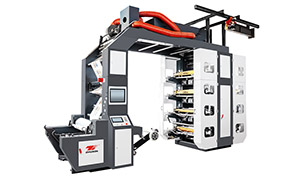
High Speed Flexo Printing Machine - Stack Flexo Flexo Printing Machine
Tension control is arguably the most critical parameter for substrate integrity and register accuracy. The web path is divided into zones: unwind-to-print, inter-deck, post-print-to-rewind. Each zone has its own tension sensor (load cell) and actuator (dancer roller or motor torque). The tension setpoint varies with substrate type: films require 0.3-0.8 N/cm width, paper 1.0-2.0 N/cm, and board 2.5-4.0 N/cm. The dancer roller, a weighted or pneumatically loaded idler, acts as a mechanical accumulator that absorbs short-term tension spikes, while the servo motor provides long-term correction via PID loops. Tuning these loops requires modeling the web's elastic modulus and mass per unit area; a poorly tuned loop causes overshoot or hunting, manifesting as stretch marks or web breaks.
Advanced control strategies include model predictive control (MPC) that anticipates tension changes from speed ramps and drying-induced shrinkage. Some presses use feedforward compensation based on substrate stiffness derived from online measurement. For stretchable films, a taper tension profile is programmed – tension decreases as the roll diameter changes at both unwind and rewind to prevent layer slippage and core crushing. The unwind motor's regenerative braking must handle the changing inertia; a dynamic brake resistor dissipates excess energy during deceleration.
Mechanical wear and maintenance: The cylinder bearings (typically high-precision angular contact ball bearings) must maintain run-out below 0.005 mm. Bearing preload is critical; excessive preload increases friction and heat, while insufficient preload allows axial movement. Vibration analysis using accelerometers can detect early bearing faults or gear mesh anomalies. The impression cylinder's surface hardness (60-65 HRC) is maintained by periodic grinding, but over-grinding reduces diameter and alters pressure settings; shims or electronic compensation are used to adjust for diameter changes.
Thermal effects: Printing generates heat from friction and drying systems, causing cylinder expansion. Steel has a coefficient of thermal expansion of ~12×10^-6 per °C; a 10°C rise in a 1-meter cylinder lengthens it by 0.12 mm, affecting repeat length. Active cooling (water circulation in the central drum of CI presses) or temperature-controlled print rooms are employed to maintain dimensional stability. The control system can also apply compensation by adjusting plate cylinder speed fractionally to correct for thermal growth.
In summary, the
flexo printing machine is a masterpiece of mechatronic integration where every component – from gear backlash to bearing preload, from PID gains to thermal compensation – must be optimized for the specific substrate mix. Modern presses incorporate self-tuning algorithms that identify the web's mechanical properties on-the-fly and adjust parameters automatically, reducing the need for expert manual tuning and enabling consistent high-quality output even with varying substrates. This mechanical depth is what separates entry-level presses from high-performance systems used in premium packaging.